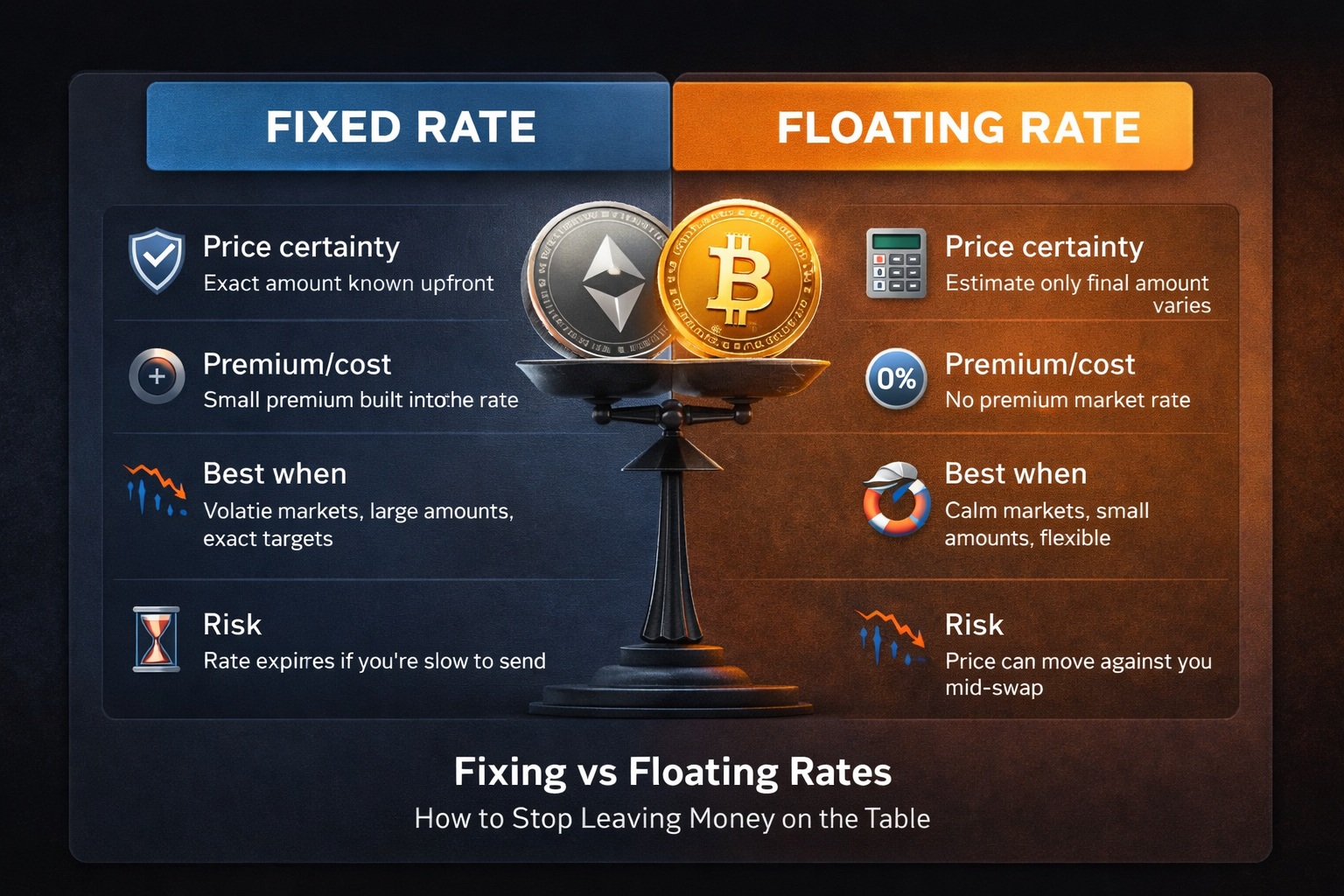
Every crypto swap involves a choice most people skip past without thinking: fixed rate or floating rate. It sounds like a minor detail. It isn’t. Depending on market conditions and the size of your swap, choosing wrong can cost you anywhere from a fraction of a percent to several percent of the total transaction.
How Each Rate Type Works
A floating rate means you get whatever the market price is at the moment your transaction is confirmed on the blockchain. You see an estimate when you start the swap, but the final amount depends on what happens between when you send and when the swap executes. If the price moves in your favour, you get more. If it moves against you, you get less.
A fixed rate locks in a specific exchange rate for a limited window — usually 10 to 30 minutes. You know exactly what you’ll receive before you send. The trade-off is that fixed rates typically include a small premium to cover the platform’s risk of price movement during that window.
| Fixed Rate | Floating Rate | |
| Price certainty | Exact amount known upfront | The estimate only final amount varies |
| Premium/cost | Small premium built into the rate | No premium market rate |
| Best when | Volatile markets, large amounts, exact targets | Calm markets, small amounts, flexible |
| Risk | Rate expires if you’re slow to send | Price can move against you mid-swap |
When to Use Which
During calm markets — when Bitcoin is trading sideways, and altcoins aren’t spiking — floating rates are usually the better deal. The price won’t move dramatically in the few minutes it takes for your transaction to confirm, and you avoid the fixed-rate premium. For small swaps under a few hundred dollars, the difference is often negligible either way, so floating saves you the premium.
During volatile markets, regulatory news, major protocol upgrades, or just a day when BTC moves 5% in an hour, fixed rates become essential. A 15-minute swap confirmation during a volatile period could trigger meaningful price movement. If you’re converting a significant amount, the fixed-rate premium is insurance worth paying for.
Transaction size matters too. If you’re swapping $50 of ETH for USDT, a 0.5% swing barely registers. If you’re swapping $10,000, that same swing is $50. The larger the transaction, the more a fixed rate makes sense.
Practical Tips
Check the spread between the fixed and floating rates before deciding. On a reputable non-KYC crypto exchange, both will typically be displayed clearly before you confirm the swap. If the fixed rate premium is minimal (under 0.5%), there’s little reason not to lock it in. If the premium is steep, it usually means the market is volatile, which is exactly when you might want the protection.
Also, fixed-rate windows have time limits. Have your sending wallet ready before locking in a rate. Don’t lock in a rate and then spend five minutes looking for your hardware wallet. Have everything prepared, lock the rate, and send immediately.
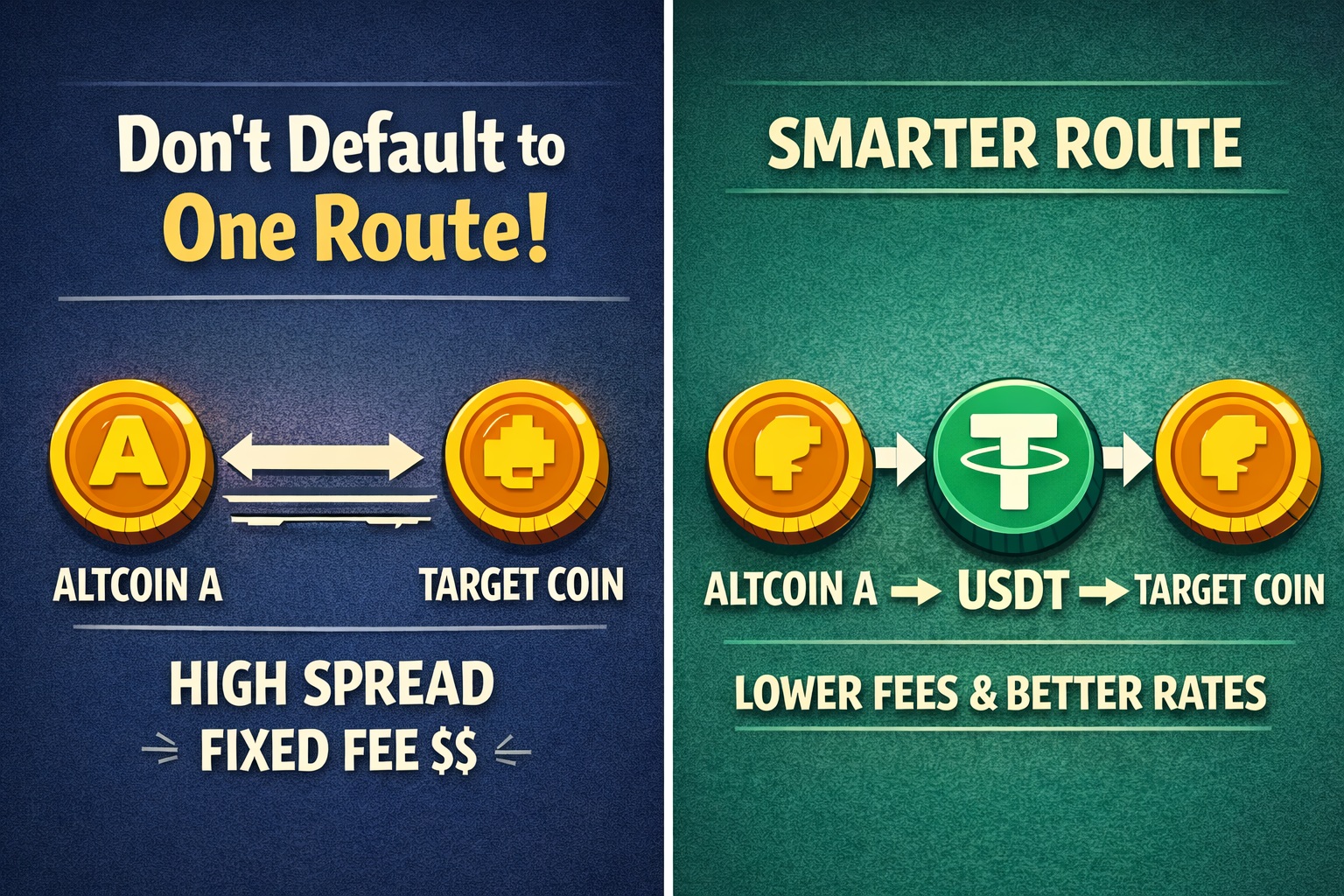
For obscure pairs with wide spreads, you’re sometimes better off routing through a stablecoin (altcoin → USDT → target coin) rather than paying a hefty fixed rate premium on an illiquid direct pair. The mistake most people make is defaulting to one option without thinking. Read the market, check the spread, and pick accordingly.